
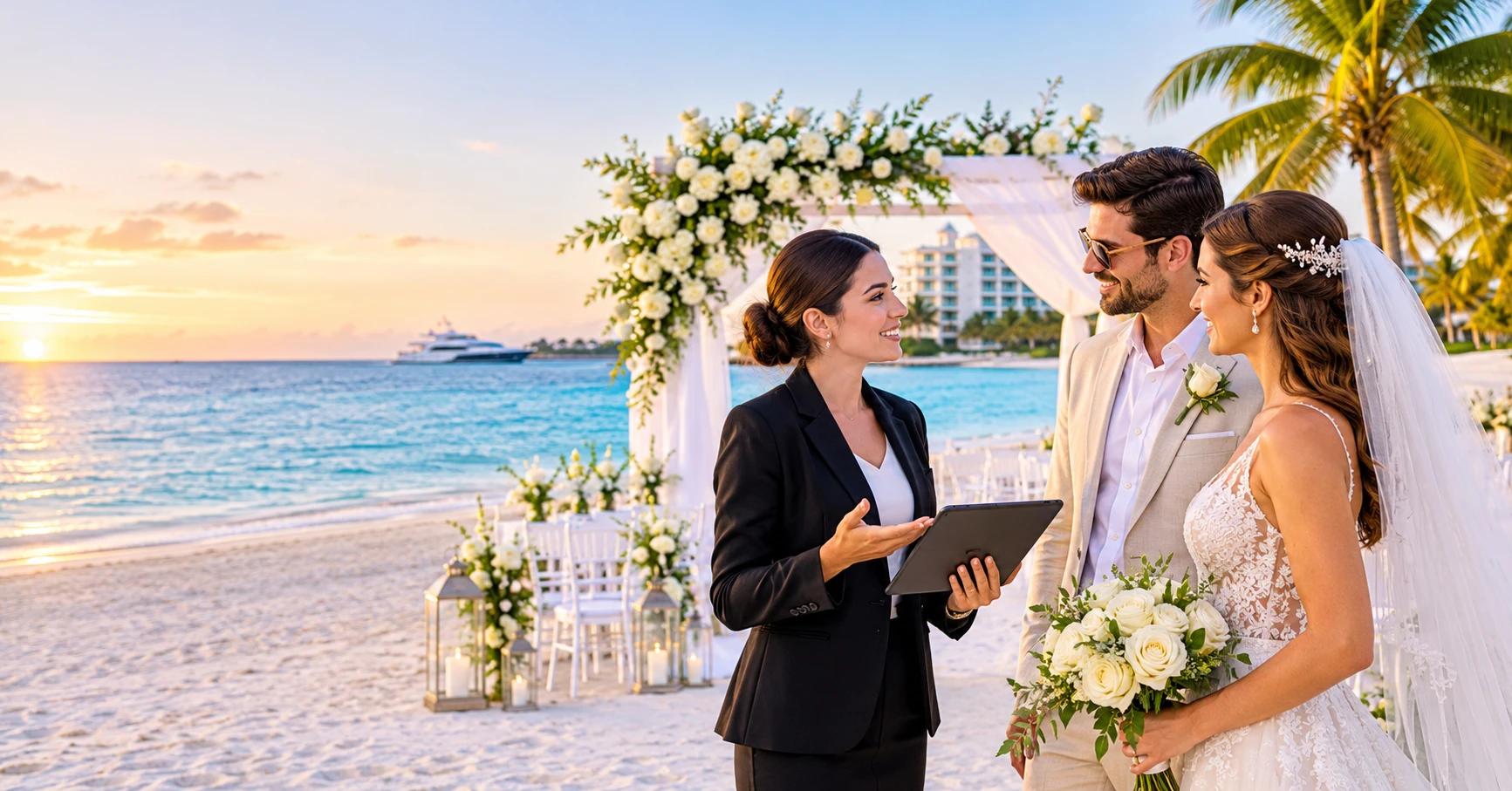
Understanding destination wedding planner Bahamas duties starts with one idea: a planner handles the coordination that turns separate bookings — venue, vendors, guests, and transport — into one wedding that runs on time. That is the short answer. The longer, more useful answer is that a planner's duties depend on the level of service you hire, and the most common disappointment is not a bad planner, but a mismatch between what couples assumed was included and what was actually agreed.
Planner, Coordinator, and Day-Of Lead: Three Different Jobs
A full-service wedding planner in Nassau usually starts months before the wedding. That planner helps shape the overall plan, recommends venues and vendors, manages the budget structure, builds the timeline, coordinates guest logistics, and leads on the day. This is the closest thing to handing the project to one accountable person.
A wedding coordinator in Nassau often starts later, once you have already booked your venue and main vendors. The coordinator's job is to take existing bookings, turn them into a workable timeline, confirm details with vendors, and run the day. A coordinator can be excellent, but one who starts eight weeks before the wedding cannot retroactively fix a venue choice, a transport gap, or a vendor conflict built into the plan months earlier.
A day-of lead is narrower still. This person is in charge on the wedding day itself: cueing the ceremony, managing transitions, holding vendors to the timeline, and solving problems as they arise. A day-of lead does not usually design the wedding, negotiate with vendors over months, or manage guest travel. If you hire only day-of help, you still need someone — you, a family member, or another vendor — to own the months of planning before that day.
Full-service planner
When it usually starts: 9–12 months before, sometimes earlier
What it typically owns: Overall plan, vendor selection, budget structure, timeline, guest logistics, day-of leadership
What it usually does not own: Your personal choices: guest list, vows, style, final approvals
Wedding coordinator
When it usually starts: After venue and main vendors are booked
What it typically owns: Timeline, vendor confirmations, rehearsal flow, day-of running
What it usually does not own: Early venue and vendor selection, long-term budget design
Day-of lead
When it usually starts: Wedding week and wedding day
What it typically owns: Cues, transitions, vendor timing, problem-solving on the day
What it usually does not own: Months of planning, guest travel, vendor sourcing
Ask every planner which service level they are offering, in writing. If the answer is vague — “we handle everything” — ask for the list that follows in this post, item by item, and mark what is included, what is extra, and what is not offered at all.
What a Full-Service Planner Typically Handles
First, a planner shapes the plan: turning your ideas, guest count range, and priorities into a realistic structure — how many events, what kind of venue suits your group, what the day should feel like, and what order decisions should be made in. A good planner will tell you when an idea does not fit your guest count, venue, or timeline, rather than agreeing to everything and letting problems surface later.
Second, a planner sources and manages vendors: recommending photographers, caterers, florists, musicians, and cake makers; requesting quotes; comparing inclusions; and checking availability. More importantly, the planner manages vendors after booking — sharing the timeline, confirming arrival and setup times, and making sure each vendor knows what the others are doing. Vendor management is where destination weddings most often fail without a planner, because vendors in different companies do not naturally coordinate unless someone makes them.
Third, a planner builds and owns the timeline (our Nassau luxury wedding planning guide shows the order decisions usually follow). This is not a pretty schedule for guests. It is a working document for vendors, with setup times, sound checks, ceremony cues, meal service, speeches, photography windows, and transport departures. It includes buffers for Nassau realities: travel between Paradise Island, Cable Beach, downtown, and private villa areas, loading time for guests in formal dress, and a weather decision point. When one person owns the timeline, changes are made in one place and shared with everyone. When no one owns it, each vendor works from a different version.
Fourth, a planner coordinates guest logistics with your transport team. In Nassau, this is a major duty, not a minor extra. It includes grouping guests by hotel, planning airport arrivals at LPIA, scheduling wedding-day shuttles and returns, and planning transport for welcome events and farewell brunches. A planner who does not ask about hotel spread, pickup points, and return times is missing a central part of a Nassau destination wedding. Equally, a transport team that does not receive the planner's timeline cannot plan pickups accurately. Planner and transport team must work from the same document. For a step-by-step system, see our guide to wedding guest transportation in Nassau.
Fifth, a planner manages communication and documentation: keeping contracts, payments, vendor confirmations, guest counts, dietary needs, and seating information in one place, and sharing updates on a schedule you agree in advance. Couples often underestimate this value until wedding week, when ten vendors ask ten questions at once. A planner who answers, filters, and escalates only what truly needs your decision protects your time and your calm.
What a Planner Does Not Decide for You
Even a full-service planner does not, and should not, take over decisions that are personal to you. Understanding this boundary prevents disappointment on both sides.
Your planner does not write your vows, choose your faith or cultural traditions, or decide what your marriage should mean. A planner can suggest ceremony structures, readings, and music, and coordinate with an officiant, but the personal content of the ceremony belongs to you and your partner.
Your planner does not guarantee legal outcomes. Paperwork for a marriage in the Bahamas, including any licence or document requirements, should be confirmed with an official Bahamian source and, where needed, a local legal contact. A planner can provide a checklist, track deadlines, and coordinate appointments, but a planner's assurance is not a substitute for official confirmation. Build paperwork into your timeline early, as a separate checklist with owners and dates.
Your planner also does not control weather, airline delays, or guest behavior. What a good planner controls is the response: a backup plan, a communication plan, and a team that can adjust without panic. Judge a planner by how they prepare for disruption, not by whether they promise a perfect day with no disruption at all.
Paperwork, Contracts, and Guest Information
Paperwork is the least glamorous part of a planner's job and one of the most valuable. A planner should keep a single record of what has been booked, what has been paid, what remains due, and what still needs your approval. That record should include venue terms, vendor arrival times, music and photography limits, end times, and cancellation or postponement terms. If you must search months of emails to find whether photography overtime is included, your planning system is not working.
Design, Guest Experience, and Transport: Where Scope Varies Most
Design scope varies more between planners than almost any other duty, so ask the most specific questions here. Some planners offer full design: mood boards, color palettes, floral design, table styling, lighting design, and coordination with rental companies. Others offer logistics planning and vendor recommendations, and expect you to hire a separate designer or florist to own the look. Still others fall in between, offering styling for ceremony and reception tables but not for welcome events.
Guest experience is a related but separate scope. Does your planner create a welcome guide, a wedding website, or a guest itinerary? Does the planner manage welcome gifts, hotel check-in information, or activities between events? Does the planner provide a contact for guests with transport or schedule questions, so those questions do not all come to you? In Nassau, where guests navigate a new city, these services can transform a wedding weekend. But they are not automatically included in every package. List them, price them if extra, and decide which matter to you.
Communication and Common Problems When Scope Is Unclear
Also ask who else the planner communicates with on your behalf. A full-service planner usually communicates directly with vendors, venue, and transport team. A coordinator may communicate mainly with vendors you have already booked. A day-of lead communicates mainly on the day itself. If you expect your planner to handle vendor emails so you do not have to, confirm that in writing. Family communication needs agreement too: some couples want the planner to be the point of contact for parents and wedding party members, others want to keep that themselves. A simple rule — one family contact, or a shared group update — prevents drift.
The most common problems all trace back to unclear scope. First, the “everything” promise: a planner says they handle everything, the couple hears design, logistics, guest travel, paperwork, and day-of leadership, and the contract actually covers only coordination from a certain date. Second, double coverage or a gap: two vendors both think they own the timeline, or neither owns transport returns, because each assumed the other had it. Third, late scope discovery: in wedding week, a couple learns rehearsal coordination or farewell brunch transport was never included. Fourth, design drift: without written approval, small substitutions accumulate into a look the couple did not choose. Fifth, day-of authority drift: family members, vendors, and friends all give instructions, and the timeline fragments. Every one of these is preventable with a single responsibility list, shared with every vendor, naming one owner per task.
Checklist: Compare Planners Fairly
Use this checklist in every planner conversation, and keep the answers side by side. It reveals scope differences a portfolio alone will not show.
Which service level is this: full-service planning, coordination, or day-of leadership only?
From what date does your service start, and what is included before that date, if anything?
Which vendors will you source, and which must we source ourselves?
Who builds and owns the master timeline, and who shares updates with vendors?
Is design included? If so, what exactly: mood board, floral design, table styling, lighting?
Is guest logistics included? Which events, which hotels, and are returns included?
Who is the transport contact on the day, and how are delays communicated?
What paperwork will you track, and what must we confirm with an official source ourselves?
How often will you update us, in what form, and how quickly do you reply?
Who leads on the wedding day, and what decisions can that person make without us?
What is included, what is extra, and what is the total cost for our guest count and events?
What happens if we postpone, change guest count, or change venue, in writing?
If a planner answers these questions clearly and in writing, you have a strong basis for trust. If a planner avoids them, rushes you to sign, or promises outcomes that depend on venues, airlines, or authorities, treat that as information, not as a reason to argue. Thank them, compare fairly, and choose the planner whose written scope matches your wedding.
Frequently Asked Questions
What does a wedding planner do that a venue coordinator does not?
A venue coordinator usually focuses on the venue's own spaces, catering, and in-house rules. An independent wedding planner usually coordinates across all vendors, including those outside the venue, and owns the overall timeline and guest logistics. Many weddings benefit from both roles, but only if responsibilities are divided clearly in writing, so no task is duplicated or missed.
Is a full-service planner worth it for a destination wedding in the Bahamas?
It depends on your distance, guest spread, and complexity. If you live abroad, cannot visit often, and have guests across multiple hotels and villas, full-service planning often saves time, prevents logistics gaps, and reduces stress. If your wedding is small, contained in one resort, and largely covered by a resort package, coordination or day-of help may be enough. Compare written scope, not just price.
What should a wedding planner handle on the wedding day?
On the day, the planner or day-of lead should cue the ceremony, manage transitions between ceremony, photographs, dinner, and dancing, hold vendors to the timeline, coordinate transport arrivals and returns, and solve small problems without interrupting you. The planner should also manage the rain-plan decision at the agreed time, if a backup plan is needed.
Do planners handle guest travel and hotel bookings?
Some planners do, some do not, and some handle only wedding-weekend logistics once guests have booked travel themselves. Ask specifically whether flight advice, hotel blocks, airport transfers, and side-event transport are included. In Nassau, airport and hotel transport planning is a major part of guest logistics, so it should never be assumed.
Who decides the wedding design if you hire a planner?
You approve the overall style, colors, and priorities, and the planner or designer turns those choices into a workable design plan. The planner should not impose a style you did not choose, and you should not be expected to source every floral or rental detail yourself if you hired full design. Agree on an approval process before orders are placed, including how substitutions are handled.
Can a planner also handle the legal paperwork for a Bahamas wedding?
A planner can provide a checklist, track deadlines, and coordinate appointments, but legal requirements should be confirmed with an official Bahamian source and, where needed, a local legal contact. Do not rely on a planner's verbal assurance alone for licence or document requirements, and build paperwork into your timeline early.
What is the difference between a wedding planner and a wedding coordinator in Nassau?
A planner usually starts earlier and owns the overall plan, vendor selection, and budget structure. A coordinator usually starts after main bookings are made and focuses on turning those bookings into a timeline and running the day. Titles vary between companies, so always compare the written list of duties rather than the title alone.
Final Thoughts
A destination wedding planner in the Bahamas is not a luxury extra or a person who simply makes your wedding prettier. At their best, planners are the local, accountable presence that holds a complex, multi-day celebration together — across venues, vendors, hotels, and transport — while you stay focused on getting married and enjoying the people who traveled to be with you.
When scope is clear, planning becomes calmer. Vendors know who to call. Guests know where to be. You know what is handled and what still needs your decision. That clarity is, in the end, what a good planner actually sells — and for a destination wedding in Nassau, it is worth choosing carefully.
Coordinate Your Wedding Guest Transport With LC Transpo
Once your planner has set your timeline, your guests still need to get to every event on time and in comfort. LC Transpo provides private chauffeur and group transport across Nassau, including airport arrivals at LPIA, hotel pickups, wedding-day shuttles, and returns after your celebration — working from your planner's timeline so transport and ceremony stay aligned. See vehicle options on the LC Transpo fleet page.
Book with LC Transpo and contact the team to discuss your wedding dates, hotel groups, and transport timeline.